Hypospadias and epispadias are conditions that are present at birth and affect the way the urinary opening develops in boys. While their names may sound similar, they involve different parts of the penis and can require different levels of medical care.
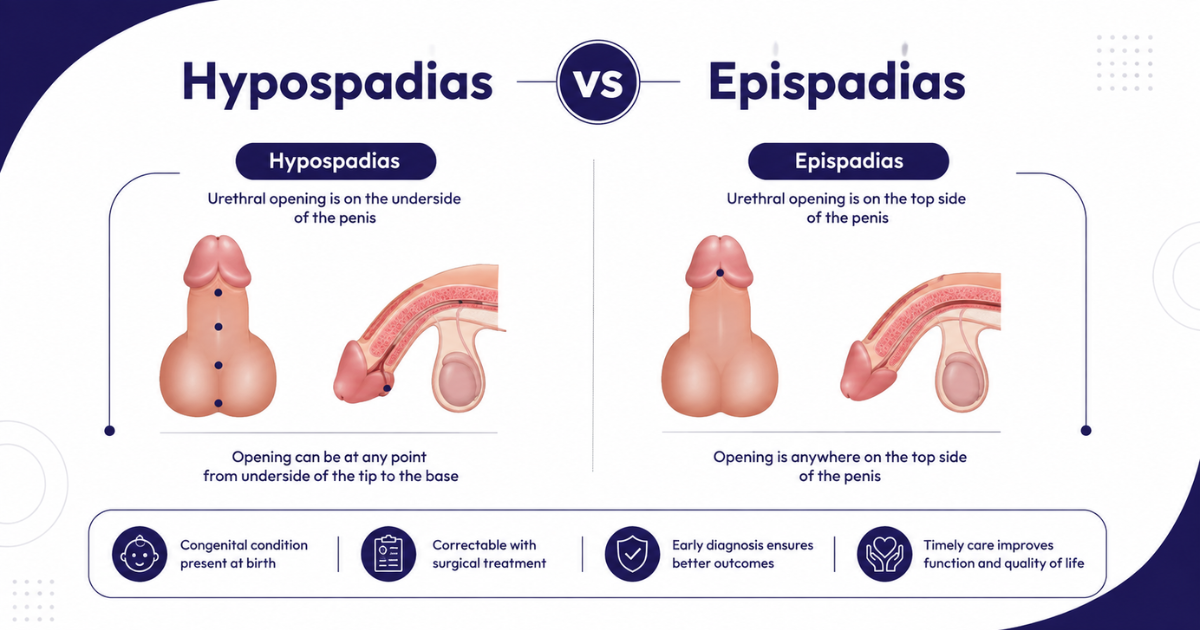
The easiest way to understand the difference is to look at the position of the urethral opening. With hypospadias, the opening is located below its usual position. With epispadias, it develops on the upper surface of the penis. Hypospadias is seen much more often, whereas epispadias is uncommon and may sometimes involve additional problems affecting the urinary system.
Understand What is Hypospadias?
Normally, urine leaves the body through an opening located at the end of the penis. In a child with hypospadias, this opening develops somewhere below the tip.
The exact position can vary from one child to another. In milder forms, the opening may be close to the normal location. In more significant cases, it may be positioned further along the underside of the penis.
Other physical features may also be present. The foreskin may not completely cover the penis and can appear more developed on the upper side. Some children also have a bend in the penis that becomes more noticeable as they grow.
Know More: What is Hypospadias?
Understand What is Epispadias?
Epispadias is a rare developmental condition in which the urethral opening forms on the upper side of the penis rather than at the end.
The condition can affect the overall appearance and shape of the penis. In some children, the penis may appear wider or shorter than usual and may have an upward curve.
Unlike many cases of hypospadias, epispadias may be connected with other abnormalities involving the bladder or urinary tract. For this reason, doctors may recommend a more detailed examination after diagnosis.
How Are Hypospadias and Epispadias Different?
The location of the urinary opening is the main feature that separates these two conditions.
A child with hypospadias has an opening positioned on the lower side of the penis. In epispadias, the opening is situated on the upper side.
There are also differences in how the conditions may affect the child. Hypospadias may change the direction of the urine stream and may be associated with penile curvature. Epispadias can involve more significant urinary concerns in some cases, particularly when the bladder or urinary control mechanisms are affected.
Hypospadias and Epispadias Comparison
| Point | Hypospadias | Epispadias |
| Location of urinary opening | Below the usual position | Above the usual position |
| Occurrence | Seen more frequently | Uncommon |
| Direction of curvature | Often bends downward | May bend upward |
| Foreskin | May be unevenly developed | May have an unusual appearance |
| Other urinary concerns | Often limited to the penis | May involve the bladder or urinary control |
| Type of treatment | Corrective surgery | Reconstructive treatment that may be more extensive |
Why Do These Conditions Occur?
The penis and urinary system develop during pregnancy. Hypospadias and epispadias occur when this development does not follow the usual pattern.
Doctors cannot always identify one specific reason for these conditions. Genetic influences and developmental factors before birth may contribute in some cases.
Parents should understand that these conditions are not usually caused by something they did or did not do during pregnancy. They are developmental conditions that are already present when the baby is born.
What Signs May Parents Notice?
The appearance of the penis often provides the first indication.
With hypospadias, parents may observe that the urinary opening is not located at the end of the penis. The child may pass urine in a downward or irregular direction. A curve in the penis may also be visible.
With epispadias, the opening can be seen on the upper surface. Depending on the extent of the condition, some children may experience difficulty with urine control.
Any unusual position of the urinary opening should be assessed by a doctor experienced in pediatric urology.
How Do Doctors Identify These Conditions?
In many children, the condition is recognised soon after delivery during the routine physical examination.
The doctor looks at the location of the urinary opening, the development of the foreskin and the shape of the penis. The presence and direction of any curvature are also considered.
Children with epispadias may undergo additional tests to check whether the bladder and urinary tract have developed normally.
For a child with hypospadias, extensive testing may not always be required. However, further assessment may be recommended in more severe cases or when other developmental concerns are present.
Do Hypospadias and Epispadias Require the Same Surgery?
The answer is no. Both conditions may require surgical correction, but the purpose and complexity of treatment can differ.
During hypospadias surgery, the aim is to reconstruct the urinary passage and position the opening appropriately. If the penis is curved, the surgeon may correct that curvature as part of the procedure.
Treatment for epispadias may involve more extensive reconstruction. In some children, surgery may also need to address urinary control or structures connected with bladder function.
The surgical plan is decided after examining the child’s individual anatomy and the severity of the condition.
Which Condition Is Seen More Often?
Hypospadias is diagnosed much more frequently than epispadias.
Because epispadias is uncommon and can sometimes involve more complex urinary issues, treatment may require specialist expertise in pediatric reconstructive urology.
What Can Parents Expect After Treatment?
The long-term outlook depends on the severity of the condition and the child’s individual treatment needs.
Many children treated for hypospadias achieve satisfactory urinary function after surgery. Long-term outcomes can also be positive regarding penile development and function.
Children with epispadias may also have good outcomes, but they may require more extensive treatment and longer follow-up, especially if urinary continence or bladder function is involved.
Regular medical monitoring allows doctors to evaluate the child’s progress as they grow.
When Should a Pediatric Urologist Be Consulted?
Parents should seek medical advice when the urinary opening appears to be in an unusual location or when the penis has an abnormal shape or curve.
An early consultation helps the doctor identify the condition and discuss whether treatment is necessary.
Circumcision should generally be postponed until a pediatric urologist has examined the child. The foreskin can sometimes be useful during reconstructive procedures, particularly in children with hypospadias.
Conclusion: Hypospadias vs Epispadias
Hypospadias and epispadias are different conditions that affect the normal development of the urinary opening. The key difference lies in where the opening is located. Hypospadias involves the lower side of the penis, while epispadias involves the upper side.
Hypospadias occurs more frequently and may affect the direction of urination or cause penile curvature. Epispadias is rare and may involve additional concerns related to the bladder and urinary control.
Both conditions should be evaluated by an experienced pediatric urologist. The treatment required depends on the individual child, the severity of the condition and whether other urinary structures are involved. Appropriate diagnosis and timely medical care can help achieve the best possible outcome.
Frequently Asked Questions: Hypospadias vs Epispadias
Q 1. What is the easiest way to tell hypospadias and epispadias apart?
Ans: The position of the urinary opening is the main difference. Hypospadias affects the lower side of the penis, whereas epispadias affects the upper side.
Q 2. Are hypospadias and epispadias present from birth?
Ans: Yes. Both are congenital conditions, meaning they develop before birth and are present when the child is born.
Q 3. Does every child with hypospadias need the same treatment?
Ans: No. Treatment depends on the position of the urinary opening, the presence of penile curvature and the severity of the individual case.
Q 4. Why can epispadias require more detailed treatment?
Ans: Epispadias may sometimes be associated with bladder development and urinary control issues. This can make evaluation and treatment more complex.
Q 5. Why should circumcision be delayed?
Ans: A pediatric urologist should first examine the child because foreskin tissue may be useful during reconstructive surgery in certain cases.
Q 6. When should parents seek specialist advice?
Ans: Parents should consult a pediatric urologist if they notice an unusually placed urinary opening, an abnormal urine stream or a noticeable difference in the shape of the penis.