Types of Hypospadias Explained

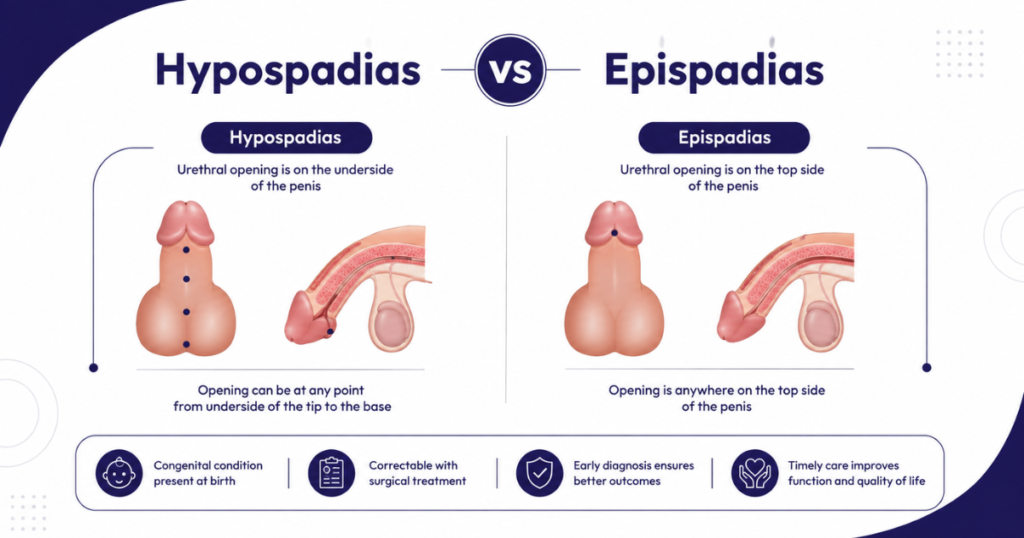
Hypospadias is classified based on the location of the urethral opening. The closer the urine opening is to the tip of the penis, the milder the condition. The farther it is from the tip, the more complex the condition becomes. The main types of hypospadias are glandular, distal, midshaft, and proximal hypospadias. Knowing the type helps doctors decide the best surgical approach and gives parents a clear idea about treatment and recovery. What Are the Types of Hypospadias? Hypospadias is not the same in every child. Some boys have only a small change in the position of the urine opening, while others have a more severe form that also affects the shape and function of the penis. Doctors classify hypospadias according to where the urethral opening is located. This classification helps in planning treatment and understanding the complexity of surgery. In most cases, surgery can successfully correct all types of hypospadias when performed by an experienced pediatric urologist. Glandular Hypospadias Glandular hypospadias is the mildest form of hypospadias. In this type, the urethral opening is located just below the tip of the penis, on the head (glans). The penis usually has a normal shape, and the urine stream may not be affected much. Many children with glandular hypospadias have only a slight difference in appearance. However, surgery may still be recommended to place the urine opening in its normal position and improve long-term function. Since this is a mild form, the surgery is generally less complex than in other types of hypospadias. Distal Hypospadias Distal hypospadias is the most common type of hypospadias. In this condition, the urethral opening is located near the tip of the penis but not on the head itself. It may be found just below the glans or around the upper part of the penile shaft. Many boys with distal hypospadias have a hooded foreskin, where the foreskin covers only the upper side of the penis. Some children may also have a mild downward bend of the penis, known as chordee. Distal hypospadias usually has an excellent success rate after surgery, and most children require only one operation. Midshaft Hypospadias Midshaft hypospadias is a moderate form of the condition. The urethral opening is located around the middle part of the penile shaft instead of near the tip. Children with this type are more likely to have a noticeable curve in the penis. The urine stream may also travel downward, making it difficult to urinate while standing. The surgical repair is slightly more complex than distal hypospadias because both the urine opening and the penile curvature may need correction. With proper treatment, most children recover well and achieve normal urinary function. Proximal Hypospadias Proximal hypospadias is the most severe type. In this condition, the urethral opening is located near the base of the penis, where the penis meets the scrotum, or sometimes even within the scrotal area. The penis is often significantly curved, and the foreskin is usually incomplete. Children with proximal hypospadias may have difficulty passing urine normally. In some cases, additional tests may be needed to check for other urinary or reproductive conditions. The surgery for proximal hypospadias is more challenging and may require advanced reconstructive techniques. Some children with severe cases may need more than one procedure to achieve the best outcome. How Do Doctors Identify the Type of Hypospadias? Doctors usually diagnose hypospadias soon after birth during a physical examination. The doctor carefully checks the position of the urine opening, the shape of the penis, the degree of curvature, and the appearance of the foreskin. No special scan is needed in most children. If the child has a severe form of hypospadias or other birth abnormalities, the doctor may advise additional investigations before surgery. Does Every Type Need Surgery? In most cases, yes. Hypospadias does not correct itself as a child grows. The purpose of surgery is not only to improve the appearance of the penis but also to help the child pass urine normally, correct any penile curvature, and support normal sexual function in adulthood. The type of hypospadias determines how complex the surgery will be, but modern surgical techniques provide excellent results for both mild and severe cases. Which Type of Hypospadias Is Most Common? Distal hypospadias is the most common type. It accounts for the majority of hypospadias cases seen in pediatric urology clinics. Because the urine opening is close to the tip of the penis, the condition is usually easier to repair than midshaft or proximal hypospadias. Which Type Is the Most Severe? Proximal hypospadias is considered the most severe form. The urine opening is much farther from its normal position, and the penis often has a significant curve. These children may require advanced reconstructive surgery, and in some cases, treatment may be completed in more than one stage. An experienced pediatric urologist is especially important for managing complex hypospadias. Does the Type Affect Recovery? Yes. Children with glandular or distal hypospadias generally recover faster because the surgery is less complex. Midshaft and proximal hypospadias may require a longer recovery period and closer follow-up. Regardless of the type, following the doctor’s instructions after surgery helps ensure proper healing and reduces the risk of complications. Can All Types of Hypospadias Be Treated Successfully? Yes. Today, almost all types of hypospadias can be treated successfully with surgery. The outcome depends on factors such as the severity of the condition, the presence of penile curvature, and the experience of the surgeon. Early treatment, usually between 6 and 18 months of age, offers the best chance of excellent functional and cosmetic results. Conclusion: Types of Hypospadias Hypospadias is classified into glandular, distal, midshaft, and proximal types, depending on where the urethral opening is located. Mild forms are usually easier to treat, while severe forms may require more advanced surgery. Regardless of the type, early diagnosis and treatment by an experienced pediatric urologist can help your child achieve normal urinary function and healthy development. If you notice that your child’s urine opening is
What Is Hypospadias? Symptoms, Causes & Treatment

Hypospadias is a birth condition in boys where the opening of the urethra, through which urine comes out, is not at the tip of the penis. Instead, it is located somewhere on the underside of the penis. In many cases, the penis may also have a downward curve, called chordee, and the foreskin may not develop normally. Hypospadias does not get better on its own, but surgery can successfully correct the condition in most children. Early diagnosis and treatment help children grow up with normal urinary and sexual function. What Is Hypospadias? Hypospadias is a condition that develops before a baby is born. During pregnancy, the urethra and penis do not form completely, causing the urine opening to be in the wrong position. The urethra is the tube that carries urine from the bladder to the outside of the body. In a healthy penis, this opening is at the tip. In boys with hypospadias, the opening may be anywhere along the underside of the penis. The condition is present from birth and is one of the most common birth conditions affecting the male urinary system. The severity of hypospadias depends on where the urine opening is located. Some children have a mild form, while others may have a more complex condition that requires advanced surgical repair. What Are the Symptoms of Hypospadias? The most noticeable sign of hypospadias is that the urine opening is not at the tip of the penis. Some children pass urine in a downward direction instead of a straight stream. This can make urination difficult, especially as they grow older. Another common sign is an incomplete foreskin. The foreskin often covers only the upper part of the penis, giving it a hooded appearance. Some boys also have a bend in the penis, known as chordee. This curve may become more noticeable during erections later in life if it is not corrected. In mild cases, parents may notice only the unusual position of the urine opening. In severe cases, both the appearance and function of the penis may be affected. What Causes Hypospadias? The exact cause of hypospadias is not always known. The condition develops during pregnancy, usually between the eighth and fourteenth weeks, when the baby’s urinary and reproductive organs are forming. Genes may play a role. A child is slightly more likely to have hypospadias if there is a family history of the condition. Hormonal changes during pregnancy may also affect the normal development of the urethra. In most cases, parents should understand that nothing they did during pregnancy caused hypospadias. It is a congenital condition that develops before birth. Types of Hypospadias Doctors classify hypospadias based on the location of the urine opening. Distal hypospadias is the mildest and most common type. The opening is close to the tip of the penis. Midshaft hypospadias means the opening is located around the middle part of the penis. Proximal hypospadias is the most severe form. The opening may be near the base of the penis or even close to the scrotum. Knowing the type of hypospadias helps doctors decide the best treatment method. How Is Hypospadias Diagnosed? Hypospadias is usually diagnosed soon after birth during the baby’s physical examination. An experienced pediatric urologist can identify the condition by examining the position of the urine opening, the foreskin, and the shape of the penis. Most babies do not need blood tests or scans to confirm the diagnosis. If hypospadias is severe or associated with other birth conditions, the doctor may recommend additional tests to rule out related problems. When Should Parents Consult a Doctor? Parents should consult a pediatric urologist as soon as they notice that the urine opening is not at the tip of the penis. It is also important to seek medical advice if the penis appears curved or the foreskin looks incomplete. Early evaluation helps doctors decide the right treatment plan before the child grows older. Parents should avoid circumcision before the child is examined by a specialist. During hypospadias surgery, the surgeon may use the foreskin as part of the repair. How Is Hypospadias Treated? Surgery is the only effective treatment for hypospadias. The goal of surgery is to place the urine opening at the tip of the penis, straighten any curvature, and improve both appearance and function. Modern hypospadias surgery has a high success rate when performed by an experienced pediatric urologist. Most children need only one operation, although complex cases may require additional procedures. The surgery is performed under general anesthesia, so the child remains asleep throughout the procedure. Most children can go home the same day or after a short hospital stay, depending on the complexity of the surgery. What Is the Best Age for Hypospadias Surgery? Doctors generally recommend surgery between 6 and 18 months of age. At this age, babies recover faster and are less likely to remember the procedure. Early surgery also helps prevent urinary problems and reduces emotional concerns later in childhood. If hypospadias is diagnosed later, surgery can still be performed successfully in older children and even adults. What Is Recovery Like After Surgery? Most children recover well after hypospadias surgery. A small tube called a catheter may remain in place for a few days to help urine drain while the surgical area heals. Parents will receive instructions about dressing changes, bathing, medicines, and follow-up visits. Some swelling and mild discomfort are normal during the first few days. Regular follow-up appointments are important to make sure healing is progressing as expected. Can Hypospadias Cause Problems If Left Untreated? Yes. If hypospadias is not treated, some children may face difficulties passing urine while standing. A curved penis can also affect sexual function later in life. In severe cases, untreated hypospadias may create fertility-related problems because semen may not be released from the normal position. Early treatment helps avoid these complications and supports normal physical development. Can Hypospadias Be Prevented? There is no guaranteed way to prevent hypospadias because it develops before birth. Most cases occur